
Louisiana Governor Urged to Address Worsening Orphaned Well Crisis
Contact
Rachel Mathews, Center for Biological Diversity, (828) 774-5636, rmathews@biologicaldiversity.org
Alex Horn, Healthy Gulf, alex@healthygulf.org
BATON ROUGE, La.— More than 700 orphaned oil and gas wells in Louisiana were once operated by the world’s largest oil corporations, according to a new analysis of state data.
Environmental, community and recreation organizations included this new data in a letter today to Louisiana Gov. Jeff Landry urging him to hold oil corporations accountable and clean up thousands of inactive oil and gas wells polluting the state’s coast within 10 years.
“Louisiana should not have to clean up messes that are connected to some of the world’s richest oil corporations,” said Rachel Mathews, a senior attorney at the Center for Biological Diversity’s oceans program. “Clean Gulf waters, thriving fish and wildlife, and a resilient coast are all possible. By fixing damaging policies and practices, the governor can hold oil companies accountable and ease the enormous financial burden that’s been foisted on the state. We urge the governor to make this a priority and leave a lasting legacy for Louisiana.”
“For my entire lifetime, companies have sued each other over these dead assets, while oil has spilled and spilled. The days-long spill from an abandoned pipeline during Hurricane Ida should have been a wake-up call. Oil companies that skip out on plugging wells are essentially cutting thousands of jobs and crippling our ability to have a clean seafloor and coastal restoration,” said Scott Eustis, community science director at Healthy Gulf. “Louisiana has lost so much land, so much opportunity, and at least one barrier island because of these derelict oil fields. Now is the time for strong leadership at the state level. We must put the ship in order, consolidate the bids, get hands on steel, and give these ghost wells a peaceful retirement. We must create the clean seafloor that allows us a future on the water.”
The Center’s analysis found that oil giants such as BP, Chevron, ConocoPhillips and ExxonMobil, or their predecessors or acquisitions, at some point operated at least 724 wells that are now orphaned in Louisiana.
Orphaned wells can be a massive financial risk. According to the analysis, the state spent at least $42.6 million to clean up just 15 orphaned well sites in 2024 and 2025 — the most expensive project involved plugging six offshore wells, costing $8.2 million.
More broadly, the analysis found that operators had not paid at least 17% of the state’s inactive well fees, amounting to $1.6 million. The state’s pay-to-delay scheme allows operators to indefinitely delay plugging inactive wells as long as they pay a minimal annual fee.
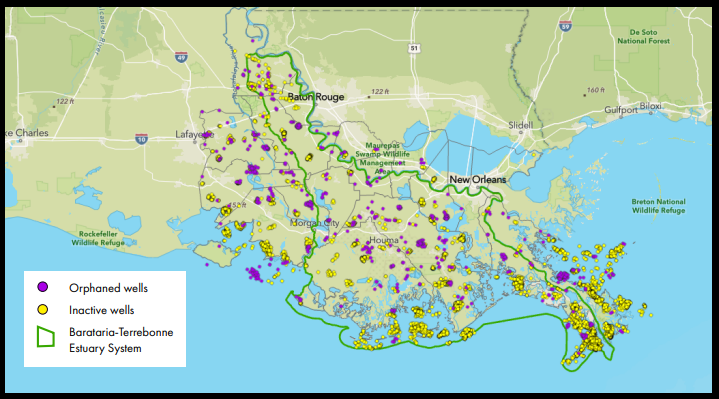
Abandoned wells threaten the biodiverse Barataria-Terrebonne Estuary, which spans 16 parishes and is the fastest disappearing landmass on Earth. There are 3,231 inactive and 509 orphaned wells in the estuary, which provides a critical buffer to storm surges and habitat for fish, crabs, shrimp, oysters and more than 400 species of migratory and resident birds.
Derelict wells are at risk of leaking oil, gas and other toxic chemicals, which can poison drinking water, smother coastal wetlands, sicken fish and wildlife, and affect workers whose livelihoods depend on a clean and healthy coast. Just this past Friday, a well that has been inactive since 1998 was found leaking oil and gas into Bayou des Allemands in Lafourche Parish.
Today’s letter says Louisiana’s derelict well crisis is growing rapidly. In a March 2025 study researchers at Louisiana State University found roughly 19,500 inactive wells and 4,900 orphan wells across the state. As of October, there are at least 22,087 inactive wells and 6,331 orphaned wells. It will likely cost billions to properly plug these wells.
In their letter, the groups call on the state to clean up all orphaned and inactive oil and gas infrastructure within 10 years, paid for by the corporations that profited from them. Getting there will require the state to:
- Track down former operators and require them to plug wells before they are declared orphaned.
- Require higher financial securities, like bonding, to cover the cost of cleanup before corporations start drilling.
- Develop a plugging plan that prioritizes entire oilfields — like those in the Barataria-Terrebonne Estuary — rather than individual wells.
- Close the loophole that allows companies to pay a fee rather than plug their inactive wells.
- Ban transfers of leases to and from companies that have overdue well-plugging obligations.
The Center for Biological Diversity is a national, nonprofit conservation organization with more than 1.8 million members and online activists dedicated to the protection of endangered species and wild places.
Healthy Gulf is a regional nonprofit working to restore the Gulf of Mexico’s waters, wildlife, and wetlands by providing the research, communications, and coalition-building tools needed to amplify community voices and reverse the long pattern of over exploitation of the Gulf’s natural resources.