
A status review must be based on the best scientific and commercial data available at the time of the review. NMFS is requesting submission of any such information on the Rice’s whale that has become available since the last status review was conducted in 2016. Threats from aggressively expanded offshore oil drilling, new ultra-deep water operations, and a mounting number of abandoned oil wells present a direct affect to the species’ recovery.
The Rice’s whale–one of the world’s rarest and most endangered whales found only in the Gulf of Mexico–is facing compounding threats to its future. From the Extinction Committee’s decision to exempt oil and gas permits from the Endangered Species Act, to BP’s new ultra-deep water oil drilling field, and erroneous statements by government officials on their genetics, these critically endangered whales are facing mounting pressure for their future.
Now the National Marine Fisheries Service (NMFS) has initiated a Status Review of the Rice’s whale under the Endangered Species Act. A Status Review is a “periodic undertaking conducted to ensure that the listing classification of a species is accurate and determine whether the species should be removed from the list (delisted); be changed in status from an endangered species to a threatened species (downlisted); or remain listed.”
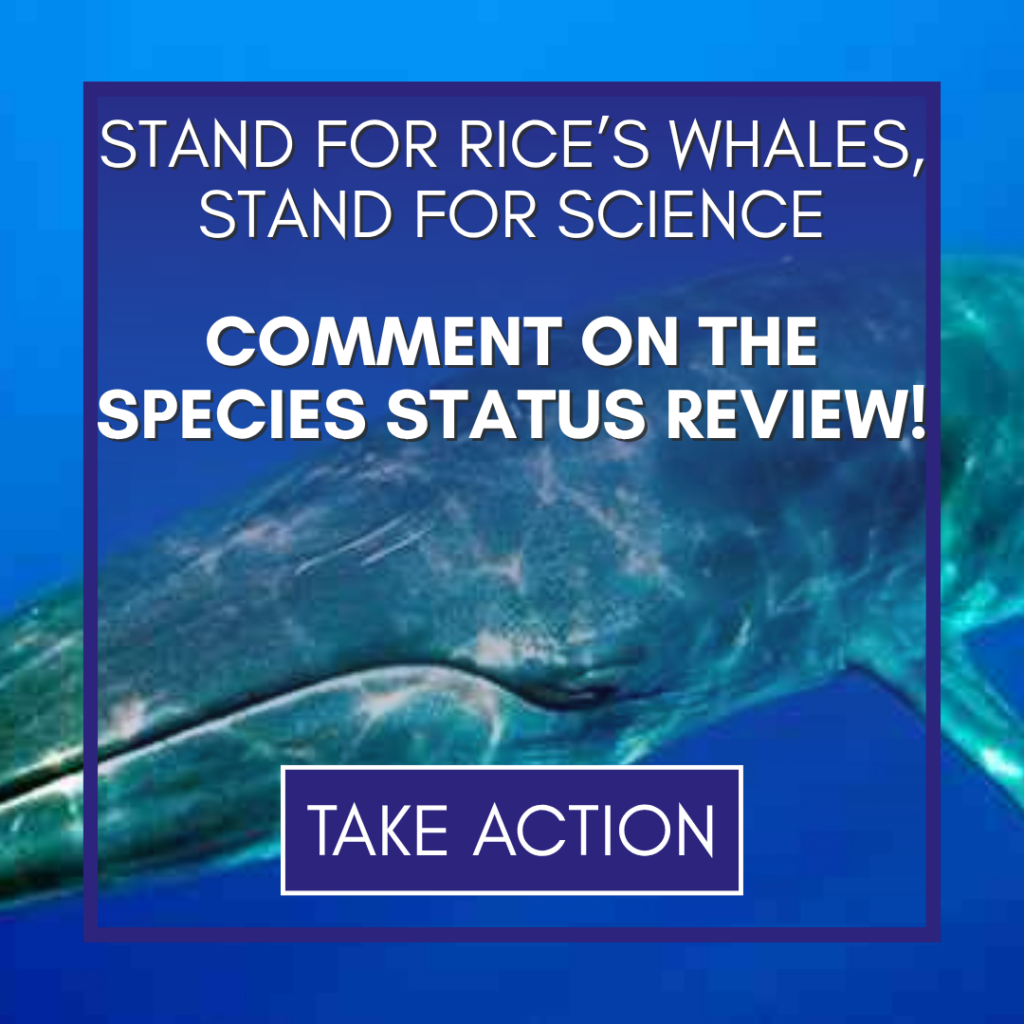
However, this Status Review shows signs of being motivated by politics rather than science. It was announced just days after Commerce Secretary Howard Lutnick, under whom NMFS operates, said in a Senate hearing that research by federal scientists which determined the Rice’s whale to be a distinct species showed “bias.” Yet Lutnick offered no proof to back up his claim, which was part of an exchange with Sen. Katie Britt (R-Ala.). Sen. Britt pushed a claim that Rice’s whales are not a distinct species, and said that “misclassifying” the whales presented a national security risk while citing a scientific paper that does not claim misclassification, according to its author.
A Status Review must be based on the best scientific and commercial data available at the time of the review. NMFS is requesting submission of any such information on the Rice’s whale that has become available since the last Status Review was conducted in 2016. Threats from aggressively expanded offshore oil drilling, new ultra-deep water operations, and a mounting number of abandoned oil wells present a direct affect to the species’ recovery.