
Mid August in Southwest Florida is an oppressive time – the stillness mingles with the humidity and equally high air temperatures, driving most people inside. But the pre-dawn morning on Sanibel Island holds a magic that only a few get to see – as the sun breaks the horizon, there are sea turtle permittees already walking the beach looking for marks in the sand. August is peak sea turtle hatching season and over 100 volunteers donate their time, energy, and hearts to monitoring and protecting the sea turtles on Sanibel and Captiva Islands in Southwest Florida.
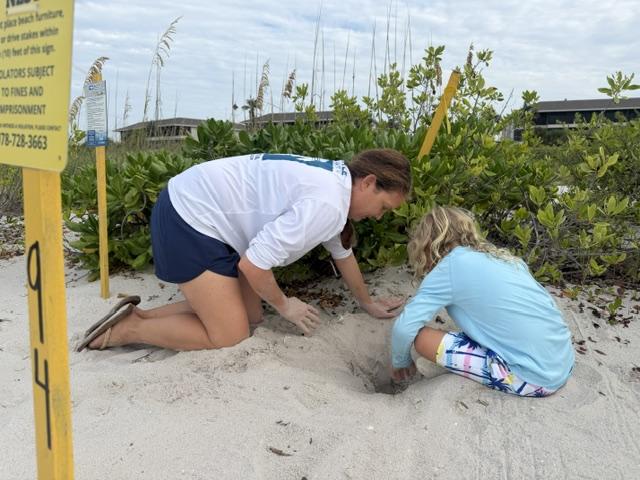
The longest running sea turtle program in the U.S. resides with the Sanibel-Captiva Conservation Foundation, a land trust and environmental nonprofit protecting the barrier islands off the Ft. Myers coast. They are leaders in sea turtle conservation and research and have a rich history of educating the public about the species. Their robust volunteer program has a year plus waitlist, but they still ensure all visitors to the island have an opportunity to learn about sea turtles, even if they can’t see them in person. Recently, my six year old and I had the opportunity to observe a sea turtle nesting survey on Sanibel, supervised by state-certified permittees.
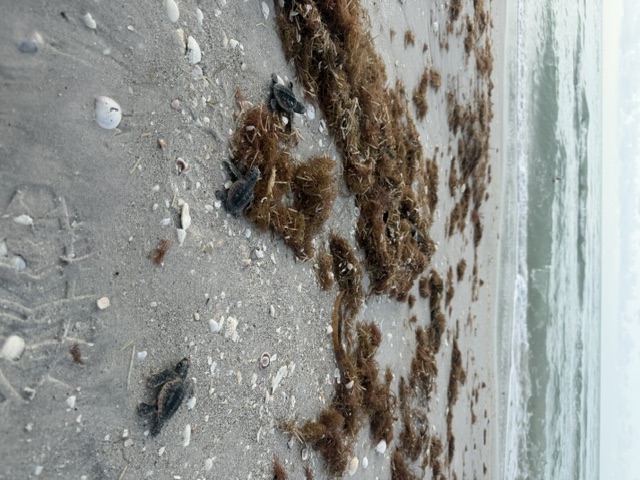
We drove across the causeway bridges to the island in the dark, talking about why we had to get up so early in the morning (nocturnal animals), how special sea turtles are, why they’re so rare, and how people can help them. Sea turtle nests are rigorously monitored and tracked, with biologists knowing when a nest hatches, which leads to an survey of the nest three days later. Biologists document how many eggs are present, how many hatched, how many didn’t, and if any signs of predators were noted. This data allows scientists and wildlife regulators to monitor the health of sea turtles populations across the country. And sometimes permittees get to help the stragglers left behind.
The experience of tiny, new sea turtles furiously paddling their inch-long flippers along the sand to get to the water is one of nature’s most inspiring feats to witness. They rush through the wrack line fueled only by nutrients received in their eggs, driven by biology and millions of years of evolution (my son loves that they’ve been around since dinosaurs), to be pummeled by the surf and tossed till they get their bearings and head out to the Gulf. Most will never return, only one in 1,000 make it to adulthood, and then only the females will come back to the beach where they were born.
My son is in awe of nature, he is amazed by flowers and birds and snakes and rocks – he is incredibly lucky to experience things like sea turtles on barrier islands, but he also understands that it’s not always beautiful. He could see the struggles the sea turtle hatchlings faced – how hard it was for them to get to the Gulf, how humans had made the dark bright, how sandcastles and beach chairs became huge obstacles, how tiny they were compared to the world – and he could understand that everyone has hard work that they must do and face. But I told him that luckily we have good humans looking out for us, and for wildlife.