
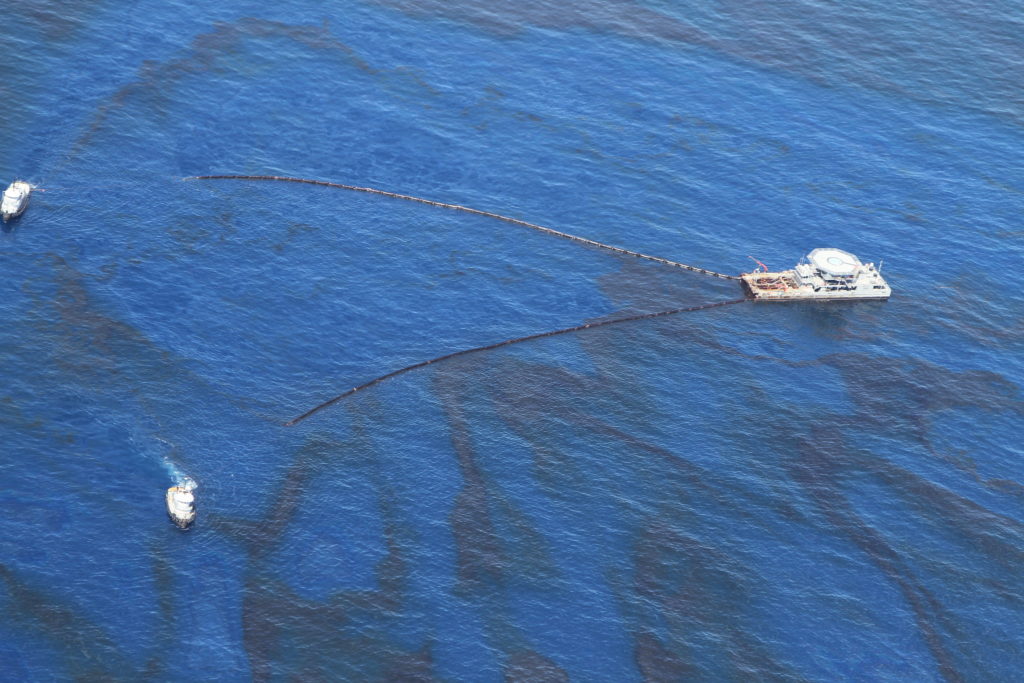
Almost sixteen years after the Deepwater Horizon Oil Spill Disaster, BP has just approved a new oil drilling development in the Gulf — Kaskida, an ultra-deepwater hub for offshore drilling has the potential to unearth 10 billion barrels of crude oil at a depth greater than 5,000 feet. The Kaskida Oilfield is the company’s first completely new project in the Gulf since the explosion of the Deepwater Horizon rig which ended 11 lives and resulted in the worst oil spill in American history. In a way, Kaskida follows directly in the legacy of Deepwater Horizon, as the Deepwater Horizon Rig discovered the Kaskida oilfield in 2006, perpetuating further parallels of recklessness.
Kaskida is emblematic of a new era in offshore oil extraction: corporate hoarding of risky, ultra-deep water leases in an attempt to monopolize the future of oil production. Profits are pursued without due diligence, proper safety requirements, nor consideration for the burden on vulnerable communities.
Louisiana was 40 miles from Deepwater Horizon and will be 250 miles from Kaskida, but the added distance provides a false sense of safety: oil from Deepwater Horizon contaminated beaches in Texas over 350 miles away.
In their proposal, BP failed to demonstrate Kaskida could safely operate with the high pressures and temperatures at the proposed depth of 6,000 feet, or even that they have the appropriate equipment to stop or contain an oil spill. BP’s own proposal incorrectly estimated the amount of oil Kaskida could spill, as well as the time it would take to stop a spill. BP’s own reporting demonstrates it lacks the qualifications to operate a high-pressure, high-temperature project.
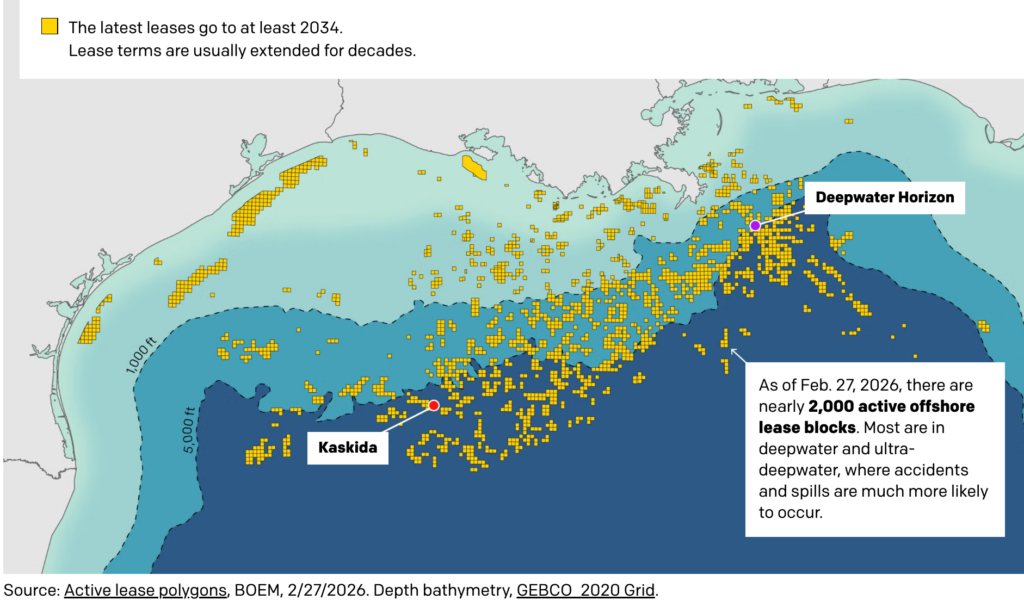
Kaskida is even riskier than Deepwater Horizon, at a depth of 6,000 feet, it is 1,000 feet deeper and would take another projected two weeks to cap the well. Deepwater Horizon spilled an estimated 134 million gallons in 87 days. Kaskida has the potential to spill 4.5 million barrels (189 million gallons) of oil into the Gulf, which could take up to 100 days to cap. However, watchdogs point out BP’s calculations miss key details, and underestimate worst-case scenarios. Any type of spill this far from shore would be even more difficult to contain and cleanup; only about 17% of Deepwater Horizon oil was recovered — getting booms and cleanup equipment this far from shore and operating there is very difficult. BP’s own Kaskida application to BOEM notes that dispersant or burning surface oil would likely be used in the event of a spill.
Kaskida would contribute to compounding injustices within the region, expanding the lifespan of harm via air pollution that escalates existing environmental injustices within the Gulf region. In the event of a spill, Port Arthur, Texas would be the nexus of a projected worst-case spill scenario. Port Arthur is already home to some of the world’s largest refineries, LNG export terminals, and petrochemical plants.
We believe that this project is another reckless iteration in BP’s deadly history in the Gulf, posing a severe threat to coastal ecosystems, communities, and climate.
Read our Joint Press Release here.