
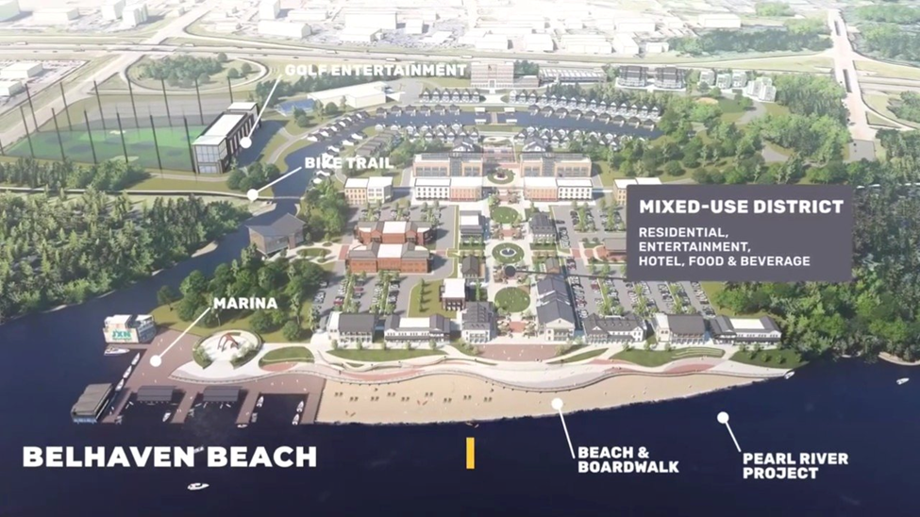
This past February, the Assistant Secretary of the Army for Civil Works, Adam Telle, released a memo that apparently gave his blessing to a combination of two flood control alternatives, D-1 and E-1 for the Pearl River in Jackson, MS. The memo was not the required Record of Decision that begins the Corps of Engineers design process, but it was a signal of support to proponents of the One Lake plan (D-1) who see building a new lake on the Pearl River for flood control as the answer to Jackson’s flooding and economic problems.
The regional law firm Burr and Forman with offices in 9 states including Mississippi posted an article about the Pearl One Lake project this May for its construction business clients on its website containing this statement:
“The approved “Alternative D1” design referred to as the “One Lake” project—marks a historic milestone after forty-five years of regional debate. The core of the “Alternative D1” plan is a massive increase in the river’s conveyance capacity, allowing it to move water away from Jackson more quickly and forcefully during flooding events while creating a reservoir to regulate flow. This will be accomplished by physically recreating approximately 954 acres along a 9-mile stretch of the river where it bisects the heart of Jackson, Mississippi.” (Burr and Forman website: From Channel to Lake: Navigating Legal Realities of the Pearl River “One Lake” Project, 5/26/2026)
Physically recreating almost 1000 acres of new land in the floodplain of the Pearl River in Rankin and Hinds Counties describes the scheme in either Alternative D-1 or E-1 to dredge and scrape the banks of the Pearl down to lower heights, and use the dredged soil and sand to build terraces or plateaus at levee height on each side of the river along nine miles from Lakeland Drive to Richland, Ms downstream of the Pearl River Interstate 20 bridge. Alternative D-1 dams the river to create a lake to go along with the new land, and Alternative E-1 just creates the land without damming the river.
The Army Corps of Engineers has a long-standing policy and a regulation that should prohibit the kind of land building in the floodplain that Alternatives D-1 and E-1 promote.
The Army Corps of Engineers Planning and Guidance Regulation that has governed this Pearl River FRM project since 2013, known as ER-1105-2-100 (published in 2000) contains the following language in its section on Flood Damage Reduction:
“Projects or separable increments producing primarily land development opportunities do not reduce actual flood damages and therefore have low budget priority. Federal participation in these projects will not be recommended”. (ER-1105-2-100, Appendix E, Section III, E-18, L(1) see page E-89.)
Land development is either a by-product or a main product of both Alternatives D-1 and E-1 depending on who you ask. The common feature of both alternatives is land creation in the floodplain, but the development opportunities that follow should not be encouraged with federal money, according to the Corps regulation above. The regulation has been in place since 2000 and has governed the Pearl River project since scoping started in 2013, so the policy against encouraging flood control projects with land building and development opportunities underwritten by federal money is not some kind of surprise. The regulation has been there all along.
Why is the Corps of Engineers leaning toward allowing a civil works project that its own regulations recommend against?
The non-federal sponsor of the project, the Rankin Hinds Pearl River Flood and Drainage Control District has directed the writing of two versions of a very pro-lake Environmental Impact Statement and has been assisted by several Jackson-based non-profit organizations over the last decade who have raised money for biased studies. With these activities and the help of Senator Roger Wicker, the late Senator Thad Cochran and other members of Mississippi’s Congressional Delegation, the Corps of Engineers’ resistance to the lake plan has been worn down. In 2007 the Corps opposed the lake plan; now the Corps seems ready to allow it.
Does the rest of Congress care that Mississippi gets to bend the Army Corps of Engineers rules in its favor? The resistance to the One Lake project from Louisiana has always been tenuous as Louisiana Republicans had to temper how tough they could be on this economic development project of the neighboring Mississippi Republicans. Louisiana’s Congressman Steve Scalise and Senator Bill Cassidy tried to focus more scrutiny on downstream effects in Congress’ 2018 WRDA bill section 1176, but that bill section had a 5-year sunset (expiration date) and in the end didn’t prove much of an impediment to another upstream lake on the Pearl River.
If One Lake (Alt. D-1) is built, Louisiana will reap all the flow and habitat problems downstream on the Pearl River and none of the economic benefits. Mississippi’s downstream counties, Copiah, Simpson, Lawrence, Marion, Pearl River and Hancock are in that same situation.